
Greetings to all fellow seekers of healing and self-discovery!
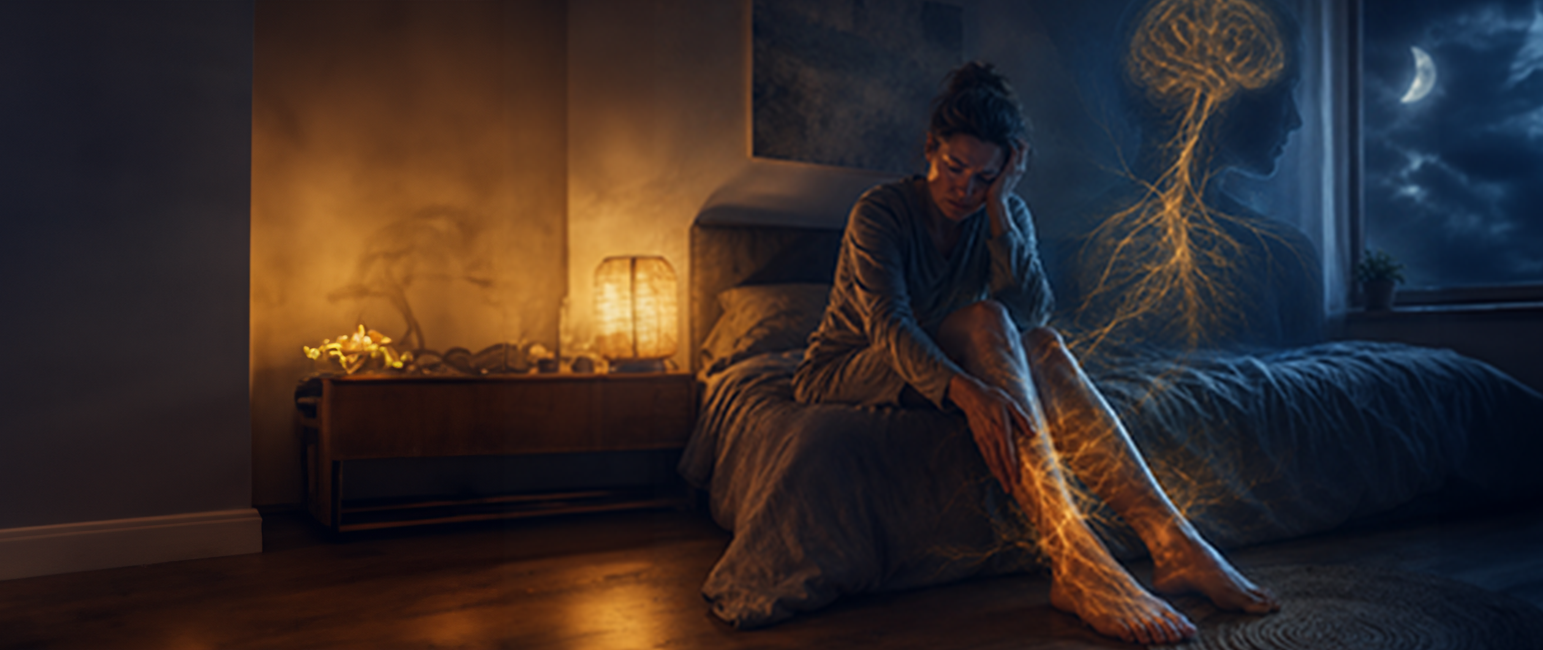
You've been looking forward to sleep all day. You finally lie down, close your eyes - and then it starts. That strange, uncomfortable crawling, tingling, electric feeling deep inside your legs. An urge so overwhelming you have no choice but to get up and walk around. The moment you move, it eases. The moment you lie back down, it returns.
If this sounds familiar, you're not alone. Restless Leg Syndrome (RLS) affects somewhere between 5 and 15% of the population - millions of people losing sleep every night, many of whom have never even heard the name for what they're experiencing.
And here's what I find most striking, after years of working with people in my practice: RLS is rarely just a leg problem. It's a window into the state of the whole nervous system.
The Body That Cannot Switch Off
To understand RLS, you need to understand one thing: your nervous system has two modes. There's the sympathetic mode - the one designed for action, alertness, and handling threat. Heart rate up, muscles primed, senses sharpened. And there's the parasympathetic mode - rest, digest, recover, sleep.
A healthy nervous system moves fluidly between these two. When the day is done, it shifts gears. You feel the natural heaviness of tiredness. You drift off.
In people with RLS, this gear-change is broken. Research shows that RLS patients have measurably elevated sympathetic nervous system activity - the body is in a state of low-grade activation even when lying still. At the same time, parasympathetic (vagal) tone is reduced - meaning the body's natural calming mechanism is quieter than it should be. Scientists call this a sympathovagal imbalance. In plain language: the foot is on the accelerator, and the brake isn't working properly.
This is why stillness becomes uncomfortable. For a nervous system running in a low-grade state of alert, lying down in the dark doesn't feel like rest - it feels like waiting. And the legs, caught in this unresolved activation, start to demand movement. Movement, after all, is what the sympathetic system is designed for.
Anxiety Is Not in Your Head
Many people with RLS also experience anxiety - and for a long time, this was brushed off as coincidence, or as the obvious stress of not sleeping well. But there search points to something deeper.
Studies consistently show that anxiety disorders and RLS co-occur at significantly higher rates than chance. The same is true for PTSD. One study found that over 40% of people with RLS had a lifetime diagnosis of a psychiatric disorder - much higher than the general population.
This isn't because anxious people are more dramatic about their legs. It's because anxiety and RLS share the same underlying terrain: a nervous system that is chronically over-activated, under-regulated, and unable to find genuine rest.
Anxiety keeps the sympathetic system elevated. An elevated sympathetic system makes RLS worse. Worse RLS means less sleep. Less sleep amplifies anxiety. Around and around it goes - a feedback loop that can quietly run for years without anyone connecting the threads.
The Clock Your Body Is Fighting
There's another dimension to this that is fascinating and often overlooked: RLS follows a strict biological clock.
Symptoms almost always peak in the evening and at night. This isn't just habit - it's wired into the body's circadian rhythm, the 24-hour internal clock that governs sleep, hormone release, body temperature, and dozens of other functions.
Here's why: the brain's iron stores - which are essential for dopamine production and nervous system regulation - naturally dip at night. Dopamine is the neurotransmitter that helps the spinal cord regulate sensation and motor control. When brain iron falls, dopamine function is disrupted, and the spinal cord becomes overexcitable. It's as if the volume knob on the sensory-motor system gets turned up - and the legs, picking up on this amplified signal, start sending urgent messages to move.
At the same time, a system called the adenosine pathway - essentially the brain's natural "slow down" signal - weakens at night in people with RLS. (This is also why caffeine makes RLS dramatically worse: caffeine works precisely by blocking adenosine). The brain loses its ability to put the brakes on, exactly when brakes are most needed.
The result: every evening, the nervous system runs a physiological experiment in what happens when rest is not safe. And the legs respond accordingly.
What's Actually Going On - Simply Put
The core of RLS is a nervous system that cannot down-regulate. Several things tend to drive this:
Brain iron deficiency - often invisible in standard blood tests, but measurably low in the brain. Iron is required to make dopamine, and dopamine is required to calm the spinal cord's motor signals. Without it, the system runs hot.
GABA and glutamate imbalance - GABA is the brain's main inhibitory chemical (the "calm down" signal), glutamate is the main excitatory one. In RLS, glutamate runs high and GABA runs low - the brain literally cannot quieten itself.
Gut health - a newer and genuinely exciting area of research. The gut microbiome affects how well iron is absorbed from food. When the gut is inflamed or dysbiotic, iron absorption drops - and brain iron follows. Many people with RLS also have digestive issues, and this may not be coincidence.
Genetics - plays a role (RLS runs in families),but genetics creates susceptibility, not inevitability. What we do with our nervous systems matters enormously.
WhatActually HelpsAddressthe Iron First
If you have RLS, get your ferritin levels checked - and know that the target for RLS patients is higher than standard ranges suggest. Most doctors are satisfied with ferritin above 12–20. For RLS, researchers now recommend levels above 75µg/L. This matters. In some cases, simply correcting iron - through diet, oral supplements, or intravenous iron (faster and more effective for the brain) —significantly reduces or eliminates symptoms.
Foods rich in bioavailable iron: red meat, liver, oysters, legumes with vitamin C to aid absorption. Avoid tea and coffee with iron-rich meals - they block absorption.
Move - But in the Morning
Exercise is one of the most evidence-backed interventions for RLS. A randomized trial found that regular aerobic exercise plus lower-body strength training significantly reduced symptom severity. The catch: timing matters. Morning exercise helps. Evening exercise can worsen symptoms by activating the sympathetic system at exactly the wrong time.
Calm the Nervous System Directly
Since RLS lives in a chronically activated nervous system, anything that genuinely activates the parasympathetic system is therapeutic. This includes:
• Slow, extended breathing - particularly longer exhales, which directly stimulate the vagus nerve (the main parasympathetic nerve)
• Warm baths before bed - help shift core body temperature in a way that actually supports the circadian transition into sleep
• Massage and bodywork - clinically studied for RLS, with measurable improvements in symptom severity and sleep quality. Focused work on calves, hamstrings, and the feet can bring significant temporary relief, and regular sessions may shift the baseline overtime
• Somatic movement practices - slow, conscious body movement re-educates the sensorimotor nervous system, helping it release chronic holding patterns in the muscles and fascia of the legs
Rethink Your Evenings
Avoid caffeine from mid-afternoon. Avoid alcohol - it initially sedates but creates are bound arousal that worsens RLS in the second half of sleep. Wind down deliberately: dim lights, reduce screens, lower stimulation. You are trying to create the conditions for a nervous system to shift gears - and it needs your help to do that.
The Deeper Invitation
I've worked with many people who carry RLS as just another thing wrong with them - another malfunction to manage. What I've come to understand is that RLS is often the body's way of broadcasting a more fundamental message: I have not learned how to rest. I do not feel safe being still.
That might be rooted in accumulated stress. In unprocessed experiences stored in the body. In a nervous system that has been running in survival mode for so long it has forgotten another mode exists.
The good news is that the nervous system is not fixed. It is plastic, responsive, and capable of learning new patterns - including the pattern of settling. Bodywork, breathwork, somatic practices, and genuine rest aren't luxuries for people with RLS. They are, in many cases, the medicine.
The legs that won't let you sleep are asking for something. Not suppression - but completion.
With heartfelt compassion and dedication,
Nisarga Eryk Dobosz - BBTRS, BCST, CI, MER, LOMI, NARM


