
Greetings to all fellow seekers of healing and self-discovery!
Try this before you read any further.
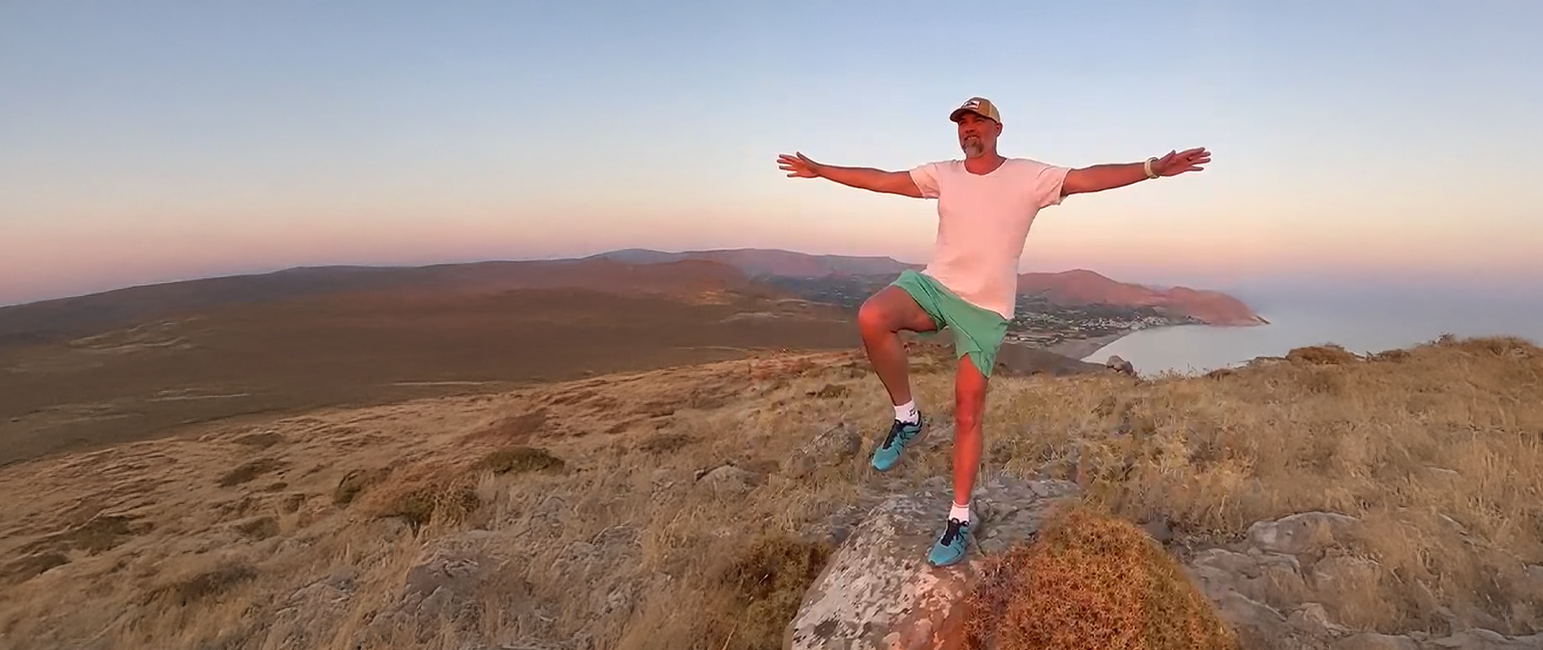
Stand on one leg. No support. See how long you last.
Ten to twenty seconds is all researchers asked of 1,702 adults in a landmark 2022 study by Araujoand colleagues, published in the British Journal of Sports Medicine. The participants were between 51 and 75 years old and were followed for just under seven years. Those who couldn't complete the test had an 84% higher risk of dying during that period. Nearly twice the risk - from ten seconds on one leg.
Most people read that and think: I should work on my balance.
I think the story goes deeper than that.
The conventional view treats balance as a marker. Something that tends to decline with age - through loss of strength, reduced coordination, neurological changes, and the gradual onset of frailty. In that sense, a balance test functions like a warning light on a dashboard. Not the problem itself, but a signal that something underneath may be quietly changing.
I don't disagree. But I see it through a different lens.
When you stand on one leg, your proprioceptive system, your fascia network, and your nervous system are all working together in real time - continuously predicting where your body is in space and, crucially, where it is about to go next. You don't consciously decide to make these adjustments. They happen before thought, before reaction. Your brain is already thousands of micro-corrections ahead of you, negotiating with gravity on your behalf.
This is what makes balance so revealing.
It isn't just a measure of strength.
It isn't just a measure of coordination.
It is a measure of organisation - of how coherently the brain can model the body, and how faithfully the body can carry out that model. The science supporting this is well established: posture and balance rely heavily on predictive, feed forward control. What I'm offering here is my own interpretation built on that foundation - that this simple ten-second test gives us a glimpse into the quality of that predictive system.
And the fascia network is not a passive player in this. It is one of the primary sensory organs through which the body understands itself. Rich in proprioceptive nerve endings, the fascial web is constantly reporting back - feeding the nervous system the information it needs to predict, adapt, and self-organise.
When that network becomes restricted, dehydrated, or disconnected through chronic tension orunresolved trauma, the quality of that information degrades. The body's ability to model itself inspace begins to slip. And that slip, accumulating quietly over years and decades, can eventuallyshow up as something as simple as an inability to stand on one leg for ten seconds.
Which brings me to posture - and why I think we have been misunderstanding it.
Posture is not a position you hold.
It is not something you fix by pulling your shoulders back.
Posture is an ongoing prediction - a dynamic, continuously updated conversation between your brain, your nervous system, and your fascia. It is less like a statue and more like a river. Always moving, always adjusting, always reorganising around the information it receives.
When we work with the body through somatic practice, breathwork, or fascial release, we are not simply stretching tissue or building strength. We are restoring the quality of that conversation. We are helping the body become better at knowing itself - and therefore better at organising itself.
That 84% statistic is striking. But what it points to, beneath the numbers, is something we can actively work with.
So go back to the test.
One leg. Ten to twenty seconds. No support.
What you felt in those moments - the micro-corrections, the subtle wobbles, the sudden grip or unexpected stillness - that is your proprioceptive fascia network speaking. It is your body's inner intelligence trying to model and predict itself in real time.
Learning to listen to it, and to work with it consciously, may be one of the most important things you can do for your long-term health, vitality, and longevity.
Balance is not just something you have or don't have.
It is something your body is - or isn't - organized enough to produce.
Nisarga Eryk Dobosz is an internationally recognized therapist and trainer specializing in Myofascial Energetic Release (MER®), Biodynamic Breathwork & Trauma Release, and somatic healing. He works with clients and trains practitioners worldwide.


